Geological Phenomena

EARTH'S QUIETER SPECTACLES

Popular natural wonders are frequently defined by gift shops, parking turnouts, and observation barricades. Earth's truly astounding features, however, are shielded by geographical friction: subterranean caverns requiring days of spelunking, desert monoliths guarded by hundreds of dry dunes, and glacial fissures visible only during brief sub-polar summers.


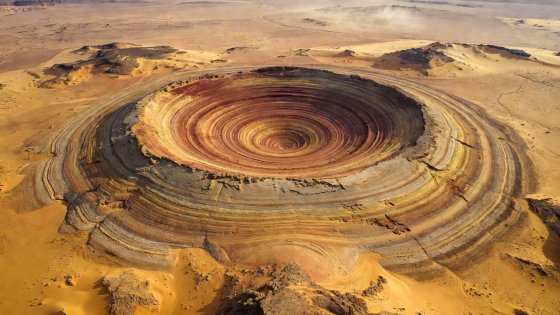
Concentric rings of the Richat Structure in the Mauritanian desert viewed from high terrain
Adrar Plateau, Mauritania Diameter: 40 km

The Eye of the Sahara (Richat)

Once theorized to be an ancient meteorite impact crater, the Richat Structure is now classified by geologists as an immense eroded alkaline domal uplift dating back to the Proterozoic eon. Reaching the center requires traversing the trackless sand plains of the Sahara via the Mauritania iron ore train corridor and chartered off-road convoys.

Observation Factor: The scale is so titanic that standing inside the rings feels like an undulating mountain ridge; the full concentric geometry is only visible from high surrounding cuestas or orbital vantage points.
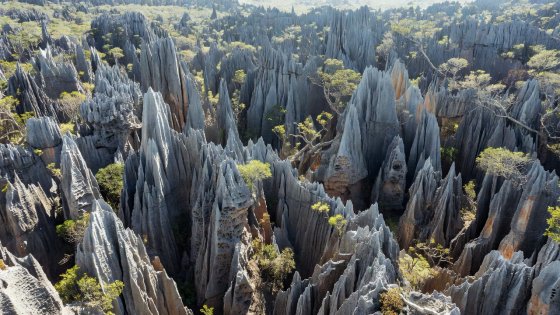
Needle-sharp limestone karst pinnacles rising like stone spears in Madagascar
Melaky Region, Madagascar Classification: Karst Stone Forest

The Tsingy de Bemaraha

The Malagasy word tsingy translates roughly to "where one cannot walk barefoot." These razor-sharp limestone labyrinths were formed when groundwater dissolved deep limestone beds, leaving vertical towers with blade-like ridges that slash through leather boots. Deep inside these ravines exist microclimates that shelter rare nocturnal lemurs and blind subterranean flora.

Access Restrictions: Exploration requires technical via ferrata equipment, fixed anchor lines, and specialized guides familiar with changing cavern bridge stability.
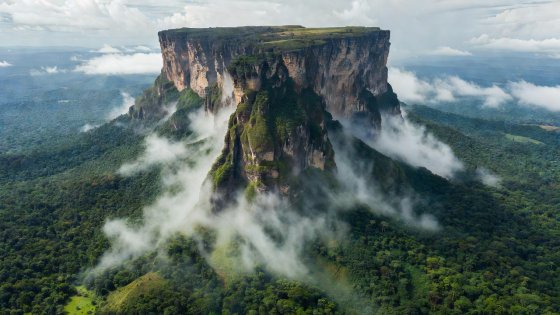
Massive sheer flat-topped sandstone tepui cliff rising above misty Amazon basin
Guiana Highlands, Venezuela/Brazil Elevation: 2,810 m

Mount Roraima’s Isolated Summit

A primordial sandstone tepui whose vertical cliff faces rise over 400 meters sheer from the Gran Sabana. The plateau summit is an alien world of blackened carved rock formations, natural quartz crystal fields, and carnivorous pitcher plants that evolved nowhere else on Earth. The summit creates its own torrential micro-climate, cascading massive waterfalls over the cliffs.

Environmental Responsibility: The top plateau has minimal topsoil. Visitors must follow strictly designated rock corridors to protect millions of years of fragile lichen evolution.
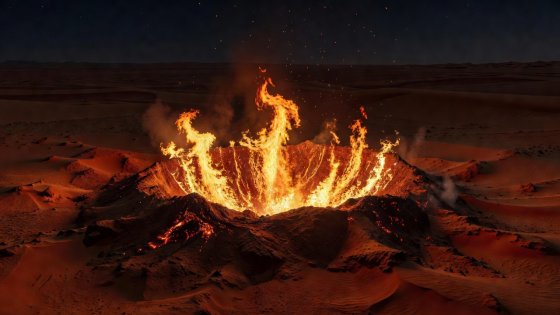
Fiery crater glowing brightly in the dark desert sands of Karakum
Karakum Desert, Turkmenistan Depth: 30 m / Diameter: 69 m

The Gates of Derweze

In 1971, Soviet geologists drilling for natural gas accidentally breached a cavernous underground methane pocket, causing the drilling rig and camp to collapse into a sinkhole. To prevent poisonous gas leakage, the engineers set the crater ablaze, assuming it would exhaust within weeks. It has burned continuously for over half a century.

Safety Warning: The edges of the crater are composed of brittle, thermally degraded sandstone prone to sudden collapse into boiling fiery depths.

Why These Places Resist Commercialization

True natural wonders remain quietly intact primarily because modern transport models fail to deliver comfortable throughput. Without airports capable of receiving commercial jets, without luxury hotel plumbing, and without smooth paved roads, only those willing to endure physical hardship, dust, cold, and self-contained camping encounter them. In preservation terms, physical friction remains the most effective environmental barrier on the planet.